

Happy weekends! It’s already May and one-third of 2023 has past just like that. I still cannot believe that it’s already been 7 weeks since I first came to Asian Rural Institute (ARI). For the past 2 months there have been so many exciting moments and I would like to share my experience here at ARI so I hope you can all tag along:)
Work life in ARI: Farm Section & Crops and Vegetables
Before I came to ARI, I set mainly two goals: to take part in hands-on works and to learn about the environment and food life.
The first goal was definitely met as ARI is full of hands-on projects. It’s actually impossible to stay in ARI and not experience direct work. I had the opportunity to work in the Farm Section where I experienced making hot beds, planting seeds, building bamboo houses to harvesting vegetables every Tuesday and Friday morning.
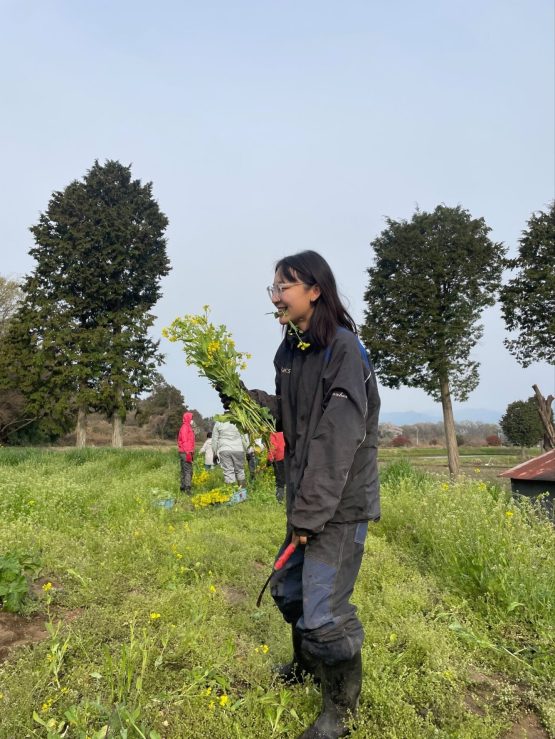
The second goal was also met easily since I was in the Farm Section and was out in the fields all day. Before coming to ARI, I didn’t even know how to use a sickle but by the end of my stay, I found myself leading newcomers and making soil with them. Observing and being a part of the planting & harvesting helped me understand the full cycle of organic farming. Not only that, it helped me appreciate the food on my dish.


Community life in ARI
Along with the learnings in the fields, I was also able to achieve my second goal through living in the community. I had so many chances to talk to people from different countries with different professions. I still remember the conversations I had with a volunteer couple from the US who were running a herb farm. They told me about GMO (Genetically Modified Organism) and how there were no policies on labelling a GMO product in their place. First of all, I didn’t even know what GMOs were and was surprised that this had been an issue. I also learned about so many more issues around the world by talking to a priest from India, a social worker from Cameroon, a student from Germany and much more.

While living in a lively community is fun, the constant human interactions can get tiring at times. In ARI, we also have non-human interactions: pigs, chicken, and goats! Working with these livestock was actually one of the most exciting parts.


>> Piglets, chicken and goats!
Nevertheless, it was always good to spend time with the ARI family. I spent most of my time in the Farm section with the “Farm-ily” and while there were deep talks, it was mainly causal life stories that filled our conversations.
Work life in ARI: PR Team & Contributing to events
Other than the farm work, I got a chance to work with the PR team and developed understandings on social media marketing. I also was asked to take pictures during the community events and to create my own original posts.
Not only working in the PR team but in ARI, if there was anything I volunteered to do, the community members were flexible and offered chances to contribute. During the 2023 entrance ceremony I was given the opportunity to play the piano and the flute. Although I was in ARI for a short period of time, the community gave me so many opportunities to take part and I’m truly grateful for that.

In Conclusion
The experiences including the learnings to the friendships I built in ARI are unforgettable. The learnings of organic farming and social issues really widened my perspective and helped me understand the global society with more dimension. All in all, I truly want to encourage anyone who is even slightly interested to come visit and experience it for yourself!
ARI Name: Sun (Wesley Foundation Intern)


